What Makes a Good Corporate Website? (2026 Guide)
 By Eslam Amin
 December 1, 2025
  13 Min Read
A corporate website is your brand’s first handshake—where customers, partners, investors, and stakeholders judge credibility fast. In 2025, great sites win by more than looks: they build trust, communicate authority, and help people reach answers or take action effortlessly. The best corporate websites pair clear structure, strong branding, intuitive UX, quality content, solid SEO, accessibility, and high performance—so your business is understood, respected, and chosen across every device and channel.
Build a Website That Feels Premium — and Performs
One message away from a fast, secure, conversion-ready website
1. Why Corporate Websites Matter More Than Ever (Updated Version)

Understanding what makes a good corporate website starts with recognizing its role in shaping how your brand is perceived—especially when you’re partnering with the best web develoment company to bring that brand to life. A corporate website is no longer just a digital brochure—it is the center of your communication strategy, the first impression for prospects, and a key indicator of your brand’s professionalism. A strong corporate website helps customers, partners, and investors understand who you are and why your business matters.
Why a Corporate Website Still Matters in 2025
- It is the primary touchpoint for most clients and stakeholders.
- It reflects your brand’s authority, trust, and long-term vision.
- It supports sales by clarifying services, products, and differentiation.
- It strengthens credibility through structure, clarity, and messaging.
- It provides a stable foundation for search visibility and long-term content.
A high-performing corporate site is not optional—it is a strategic asset that directly affects your brand reputation and business growth.
Now that the role of a corporate website is clear, let’s explore the core principles that define an effective and trustworthy site.
2. Core Principles of a Good Corporate Website
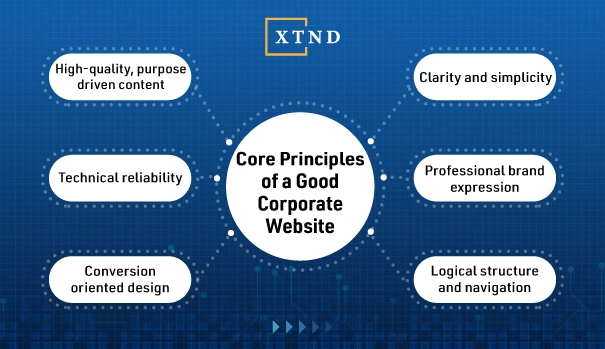
To understand what makes a good corporate website, you need to look at the foundational principles that shape its structure, credibility, and user experience—How to Choose a Good Web Design Company. Corporate websites serve diverse audiences—customers, partners, investors, media, and job seekers—so the foundation must be strong, clear, and built for trust.
Core Principles Every Corporate Website Must Follow
- Clarity and simplicity – Users must understand who you are and what you offer within seconds.
- Professional brand expression – Visual identity must reflect authority and consistency.
- Logical structure and navigation – Users should reach key pages with minimal effort.
- High-quality, purpose-driven content – Messages must be clear, corporate-friendly, and helpful.
- Technical reliability – Fast loading, secure architecture, and mobile optimization.
- Conversion-oriented design – Every page should support a business goal or user action.
A good corporate website doesn’t rely on trends—it relies on principles that communicate strength, trust, and clarity at every interaction.
Now let’s break down how a corporate website communicates authority through brand identity and visual consistency.
3. Brand Identity: How a Corporate Website Communicates Authority
A strong brand identity is one of the clearest indicators of what makes a good corporate website. Corporate audiences expect professionalism, consistency, and confidence at every touchpoint. Your website must communicate who you are—visually and verbally—within seconds. A high-performing corporate site expresses authority not through design alone, but through alignment between visuals, messaging, and brand positioning.
Key Elements of a Strong Corporate Brand Identity
- Consistent visual system — unified colors, typography, spacing, and layout patterns.
- Clear, professional tone of voice — confident, concise, and aligned with your industry.
- High-quality imagery and graphics — brand-aligned visuals that reflect credibility.
- Example Box — Weak vs. Strong Brand Identity Weak Corporate Website:
Different fonts on each page, inconsistent colors, generic stock photos, unclear messaging.Strong Corporate Website:
Unified branding across all pages, consistent visuals, polished copywriting, and a clear corporate narrative. Purpose-driven messaging — communicates mission, value, and differentiation quickly.
A corporate website must reflect authority at first glance. Professional branding builds trust instantly and positions your company as a credible, reliable player in your market.
Next, we’ll break down how to structure your corporate website using effective information architecture that guides users clearly and logically.
4. Information Architecture: Structuring Pages the Right Way
Clear information architecture is one of the strongest indicators of what makes a good corporate website. Corporate users expect logic, simplicity, and quick access to the information they need—whether they are customers, partners, job seekers, or investors. A well-structured website reduces friction, improves navigation, and reinforces your brand’s professionalism.
What Good Information Architecture Includes
- Logical page hierarchy
- Predictable, intuitive navigation
- Clear grouping of services and products
- Minimal clicks to reach key pages
- Clean URLs and consistent naming
- Easy access to contact and support information
Two-Column Comparison: Good vs. Weak Information Architecture
| Strong IA | Weak IA |
| Clear page hierarchy | Overloaded menu with too many options |
| Predictable navigation | Inconsistent or confusing labels |
| User-focused grouping | Company-centric structure |
| Clean, scannable layouts | Dense pages with long blocks of text |
| Easy access to key actions | Important pages buried deep |
Good information architecture creates a smooth journey for every visitor, no matter their intent or familiarity with your brand.
Next, let’s explore what corporate audiences expect from the user experience (UX) of a modern business website.
5. User Experience (UX): What Corporate Audiences Expect
User experience is a core part of what makes a good corporate website—especially in a custom buile website. Corporate visitors—clients, partners, investors, and potential hires—expect clarity, confidence, and efficiency. A strong UX helps users find what they need quickly, reduces friction, and reinforces the professionalism of your brand.
Key UX Expectations for Corporate Websites
- Clear, predictable navigation
- Fast-loading pages with minimal distractions
- Well-structured content with short, scannable sections
- Mobile-friendly layouts across all core pages
- Strong internal linking for easy page discovery
- Visible contact and support pathways
| Pro Tip — Corporate UX Rule Corporate users don’t browse for fun—they browse for purpose. Prioritize clarity over creativity, and always reduce unnecessary clicks. |
Good UX strengthens trust, improves engagement, and makes your corporate website easier to use for every audience segment. Now let’s explore how visual design standards shape the professionalism and credibility of a corporate website.
6. Design Standards: Visual Consistency and Professionalism
Design quality is a key element in determining what makes a good corporate website. Corporate audiences expect clean layouts, consistent branding, and polished visuals that communicate authority. A professional design system ensures that every page feels unified, trustworthy, and aligned with the company’s identity.
Core Corporate Design Standards
- Consistent typography and spacing
- Balanced white space and visual hierarchy
- Brand-aligned color palette
- High-quality images and graphics
- Clean, distraction-free layouts
✔ Mini Corporate Design Checklist
| Element | Checklist |
| Colors | Consistent + aligned with brand identity |
| Typography | Professional, readable, and unified |
| Layout | Clean spacing and clear hierarchy |
| Imagery | High-quality, relevant, brand-focused |
| Icons & UI | Consistent style across all pages |
A visually consistent design strengthens credibility and ensures a smooth, professional experience for every visitor.
Next, we’ll examine how content quality and messaging influence the clarity and impact of a corporate website.
7. Content Quality: Messaging, Tone, and Clarity
Content is one of the strongest indicators of what makes a good corporate website. The way a company communicates—its tone, clarity, and message structure—directly affects trust and perception. Corporate audiences expect content that is purposeful, concise, and aligned with the brand’s voice.
What Strong Corporate Content Looks Like
- Clear and concise messaging without unnecessary complexity
- A professional tone that matches the company’s industry
- Well-organized content with headings, lists, and short paragraphs
- Benefit-driven language that explains value, not features
- Consistent terminology across all pages
| Example Snippet — Strong Corporate Message Weak: “We offer many services and try to meet all client needs.”Strong: “We deliver structured, results-driven solutions designed to help organizations operate more efficiently and grow with confidence.” |
High-quality content ensures that every visitor understands who you are, what you offer, and why your brand deserves their trust.
Next, let’s explore the technical performance standards every corporate website must meet to stay fast, secure, and reliable.
8. Technical Performance: Speed, Stability & Security
Technical performance is a critical factor in what makes a good corporate website. Corporate users expect fast-loading pages, secure connections, and a reliable browsing experience on any device. Slow or unstable websites reduce trust immediately—especially in professional industries where credibility is everything.
Key Technical Performance Requirements
- Fast page loading times (under 2 seconds)
- Mobile optimization across all key pages
- Strong security layers: SSL, firewall, backups
- Clean, lightweight code for stability
- Hosting optimized for performance and uptime
- Regular updates to plugins, themes, and core files
Mini Technical Performance Table
| Metric | Recommended Standard | Why It Matters |
| Page Speed | Below 2 seconds | Improves UX + SEO trust signals |
| Security | SSL + Firewall | Protects user data & corporate reputation |
| Mobile Performance | Fully responsive | Most corporate traffic is mobile |
| Uptime | 99.9%+ | Ensures reliability for stakeholders |
Strong technical performance builds trust, enhances SEO, and ensures your corporate website delivers a smooth experience at all times.
Next, we’ll look at the essential SEO foundations that help corporate websites rank and remain discoverable.
9. SEO Foundations for Corporate Websites
SEO is a core element of what makes a good corporate website, because even the strongest design and messaging will not matter if no one can find the website. Corporate SEO focuses on visibility, clarity, authority, and technical readiness, ensuring the site ranks well and attracts the right audience.
Essential SEO Elements for Corporate Websites
- Clear on-page structure with proper H1–H3 hierarchy
- Optimized metadata aligned with user intent
- High-quality, authoritative content
- Internal linking that guides users and search engines
- Fast loading speed and technical cleanliness
- Structured data for enhanced SERP visibility
Best Practices Box — Corporate SEO Essentials
- Use clear page titles that reflect business terminology
- Add schema markup (Organization, Services, Breadcrumbs)
- Keep URLs short, logical, and consistent
- Optimize for featured snippets and AEO
- Maintain strong E-E-A-T through authoritative content
A strong SEO foundation ensures your corporate website is discoverable, reliable, and aligned with the search behavior of your target audience.
Next, we’ll explore accessibility standards and compliance measures every corporate website must follow.
10. Accessibility & Compliance (WCAG + Global Standards)
Accessibility is a core requirement of what makes a good corporate website. A corporate site must be usable by everyone—including people with disabilities—and must comply with global standards such as WCAG. This is especially important for companies that operate internationally or serve government, healthcare, or financial sectors.
Key Accessibility Requirements
- Proper color contrast for readability
- Keyboard-friendly navigation
- Alt text for all images
- Clear text hierarchy for screen readers
- Forms designed with accessible labels
- Buttons and links are large enough for easy interaction
| 3-Line Accessibility SummaryA compliant corporate website is inclusive, readable, and easy to navigate. Following WCAG standards improves UX for all users—not only those with disabilities. Accessibility also enhances SEO and reduces potential legal risks. |
Strong accessibility and compliance make your website more trustworthy, more usable, and more aligned with global professional standards.
Next, we’ll explore the conversion elements that help corporate websites generate inquiries, leads, and business outcomes.
11. Conversion Elements Every Corporate Website Should Include
Understanding what makes a good corporate website also means recognizing that it must support real business outcomes. A corporate site is not only about presenting information—it should guide visitors toward clear next steps, whether that’s an inquiry, a meeting request, or a resource download.
Key Conversion Elements for Corporate Websites
- Clear primary CTA on key pages (e.g., “Contact Sales”, “Book a Call”)
- Secondary CTAs for low-commitment actions (e.g., “Download Brochure”)
- Simple, well-designed contact and inquiry forms
- Visible contact details and multiple communication options
- Trust signals: client logos, case studies, certifications
Core Conversion Elements Overview
| Element | Purpose |
| Primary CTA | Drives direct leads and inquiries |
| Secondary CTA | Builds engagement and nurturing |
| Contact Forms | Captures structured information |
| Contact Details | Reduces friction and uncertainty |
| Social Proof | Reinforces trust and credibility |
Strong conversion elements turn a corporate website from a static presence into an active driver of business opportunities.
Next, let’s look at examples of high-performing corporate websites and what they do particularly well.
Essential Pages Every Corporate Website Must Include
A strong corporate website must include clear, structured pages that help users understand your company quickly. The essential pages are: Homepage, About, Services or Solutions, Industries Served, Case Studies, Leadership, Careers, and Contact. These pages form the core of a professional corporate website and ensure users can access the information they need without friction.
Before looking at real-world examples, it’s important to understand the essential pages that make up a strong corporate website.
12. Examples of High-Performing Corporate Websites
One of the clearest ways to understand what makes a good corporate website is to learn from real-world examples. The following companies demonstrate strong execution in branding, clarity, structure, UX, and conversion strategy—key elements that define a high-performing corporate site.
Strong Corporate Website Examples
1) Deloitte
Clear structure, strong authority messaging, and a professional content hierarchy designed for multiple audiences.
2) McKinsey & Company
Exceptional content clarity, elegant UX patterns, and a design system that reinforces credibility and expertise.
3) Microsoft
Consistent visual identity, accessible layouts, and user-focused navigation that guides different business segments.
4) Siemens
Modern design with strong storytelling, concise industry pages, and reliable technical performance.
These websites succeed because they combine clarity, branding, and structure with a frictionless user experience—exactly what corporate audiences expect.
Now let’s answer the most common questions businesses ask when evaluating what makes a corporate website truly effective.
13. FAQ: What Makes a Corporate Website Effective?
1) What makes a corporate website good?
Clear structure, strong branding, professional content, fast performance, and easy navigation.
2) How important is design for a corporate website?
Design strongly influences trust and credibility—consistency and clarity matter more than creativity.
3) Should a corporate website focus on conversions?
Yes. Even informational corporate websites need clear CTAs, contact pathways, and trust elements.
4) What content should a corporate website include?
Company overview, services, industries served, case studies, leadership profiles, and contact options.
5) How often should a corporate website be updated?
At least quarterly, content, security patches, and performance optimizations must stay current.
Finally, let’s wrap up with a conclusion that summarizes the key principles of a strong corporate website and reinforces how these elements work together.
| Corporate Website Recap (AEO-Ready)A good corporate website is: Clear and easy to navigate Consistent in branding and messaging Fast, secure, and technically optimized Built with strong UX and content structure Designed to support business goals and conversions Accessible, responsive, and compliant Focused on trust, clarity, and user needs This is the foundation of what makes a good corporate website in 2025. |
14. Conclusion — Building a Website That Reflects Your Brand Strength
A strong corporate website is built on clarity, structure, credibility, and performance. Understanding what makes a good corporate website helps you evaluate your current site and identify the improvements needed to create a stronger digital presence. When design, content, UX, technical performance, and branding work together, the result is a website that communicates authority and supports real business goals.
A professional corporate website is not defined by trends—but by how effectively it serves your audience, represents your brand, and drives meaningful engagement.
Summary
A good corporate website is clear, structured, consistent, fast, secure, and designed to support business goals with strong branding and user-focused content.
| Need a Corporate Website That Truly Represents Your Brand?If you’re unsure where your current website stands, a professional audit can save you months of trial and error. At XTND, we help businesses build fast, secure, and credible corporate websites designed to convert.Get your free consultation — and discover exactly what your website needs to perform better. |

I’m Islam Amin, a professional content writer helping businesses and brands build a strong digital presence through impactful, audience-focused writing that transforms ideas into meaningful content and drives real results across the online landscape.